Background
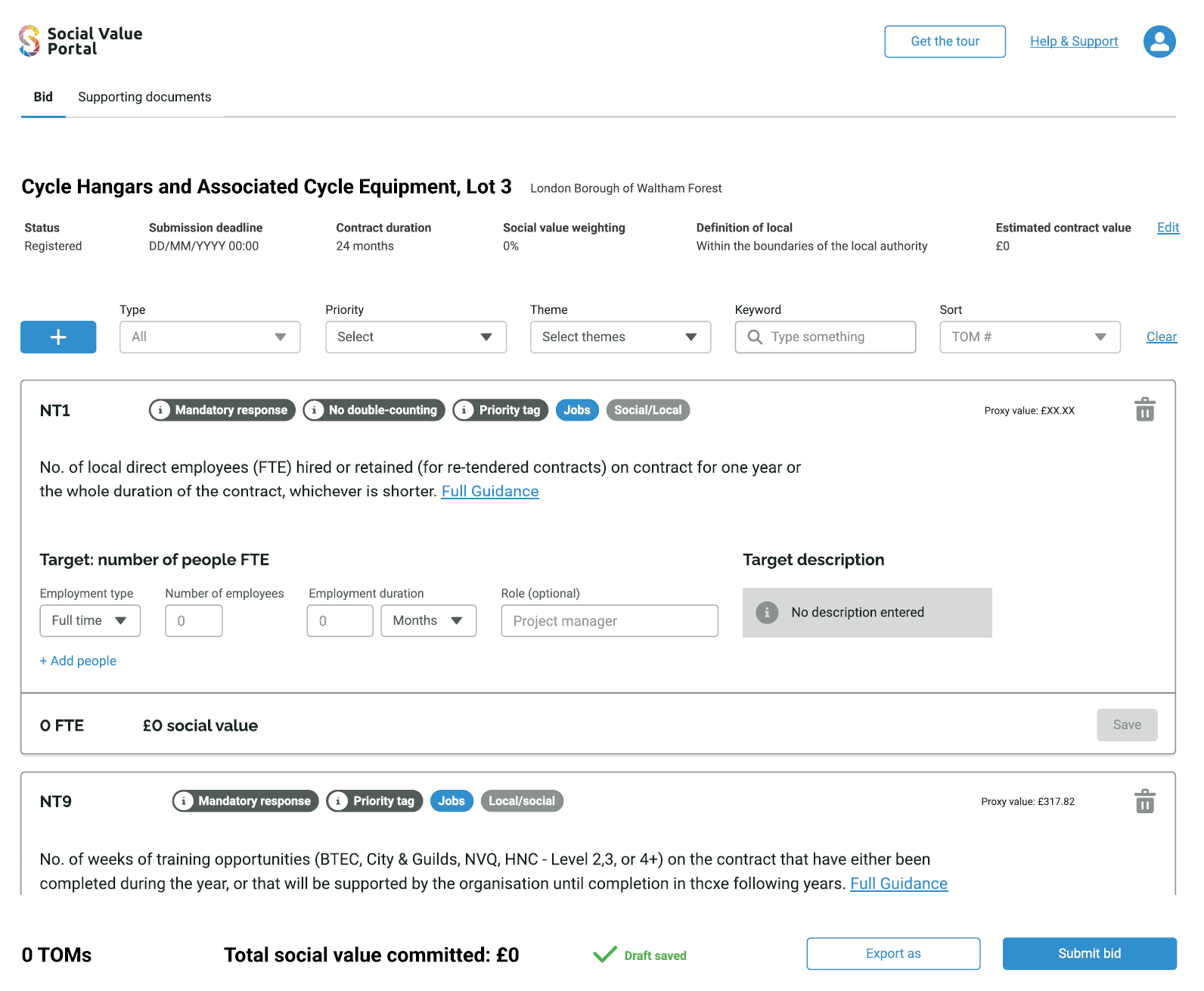
At Social Value Portal, a critical part of the platform is the social value calculator – the section where users enter their data and upload supporting files. The entire platform is predicated on users entering the correct data, so businesses can robustly aggregate and report social value.
The biggest group of users were suppliers: companies mandated to use the software by procuring organisations in order to win new business. The problem was that supplier users had the lowest NPS scores and were generating the most customer support requests. Fundamentally, their experience needed improving.
The overarching business objective was to improve supplier NPS, and I led the product team's contribution to this goal. Here's how I approached the epic.
Defining the OKRs
As a business we set OKRs for all epics, so my first step was to define them by facilitating a workshop with key stakeholders. I brought two inputs to the session: the data and user insights we had gathered about the supplier journey, and the key Jobs to Be Done (JTBD) for a supplier user.
The data told a clear story. Suppliers were entering data incorrectly, creating additional work for our evaluations team and feeding back negatively into the end user experience. Over 20% of suppliers were bouncing before completing their submission, and user interviews revealed they felt frustrated by how long the process took.
The key JTBD for the user was to win new business – but this was harder if they struggled to submit a strong response or lacked the capacity to complete the process.
After workshopping with post-its and synthesising our thinking, we landed on two distinct objectives (key results are not disclosed for confidentiality reasons):
Make it quicker to enter data
Make it easier to enter data right the first time
Understanding the Problem
To deliver these OKRs we needed to identify and validate the highest-value problems to solve. Key business stakeholders – from designers to customer success – had plenty of ideas about solutions, but I always believe it's essential to map out the problem statements first.
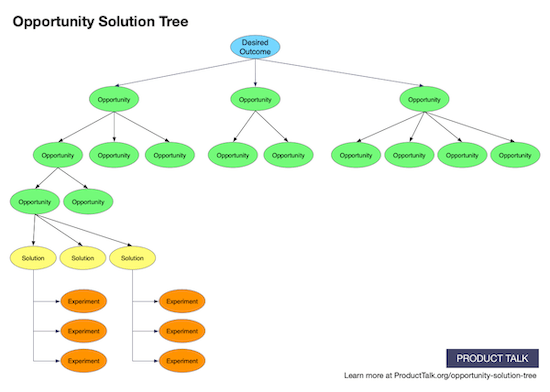
I also wanted to build consensus among stakeholders and develop deep user empathy within the scrum team. To achieve both, I facilitated an Opportunity Solution Tree (OST) workshop, as pioneered by Teresa Torres. The goal was to map all the opportunities we believed existed, group them under each objective, and identify the high-priority problems to test and validate.
Here's how I ran the workshop:
-
1
Everyone writes 5 opportunities on post-it notes, framed as user problems – written from the user's perspective, like a user story (e.g. "I don't understand the question guidance").
-
2
We go around the group explaining each opportunity and grouping them into similar themes. Anything unrelated to our two objectives is marked as out of scope.
-
3
We build the tree – adding a node for each theme and grouping opportunities in a hierarchy beneath them.
-
4
Once the OST is complete, we dot-vote on our top three problems to solutionise.
-
5
Our UX designer and I take those top problems away and prepare to test solutions.
Prototype Testing
With many interested stakeholders, our designer and I kept tight control of the direction to prevent scope creep and maintain pace. Working without the wider OST group, we ideated and prototyped five key UX changes we believed would have the biggest impact. We then presented them back to internal stakeholders, justifying our decisions and securing their backing.
I led on user recruitment for testing, knowing it was critical to test with a range of personas – users from large and small organisations, people new to the system, and those with more experience. Getting user recruitment right is something I feel strongly about: it's easy to bias a test before it's even begun.
Our designer built interactive lo-fi prototypes and we tested them with 15 users. I work in product trios, so the lead developer was invited to observe sessions, and recordings were shared with the wider scrum team to build empathy through the design phase. The synthesis from those 15 sessions shaped everything that followed.
Wireframes, Visual Designs and Developer Hand-off
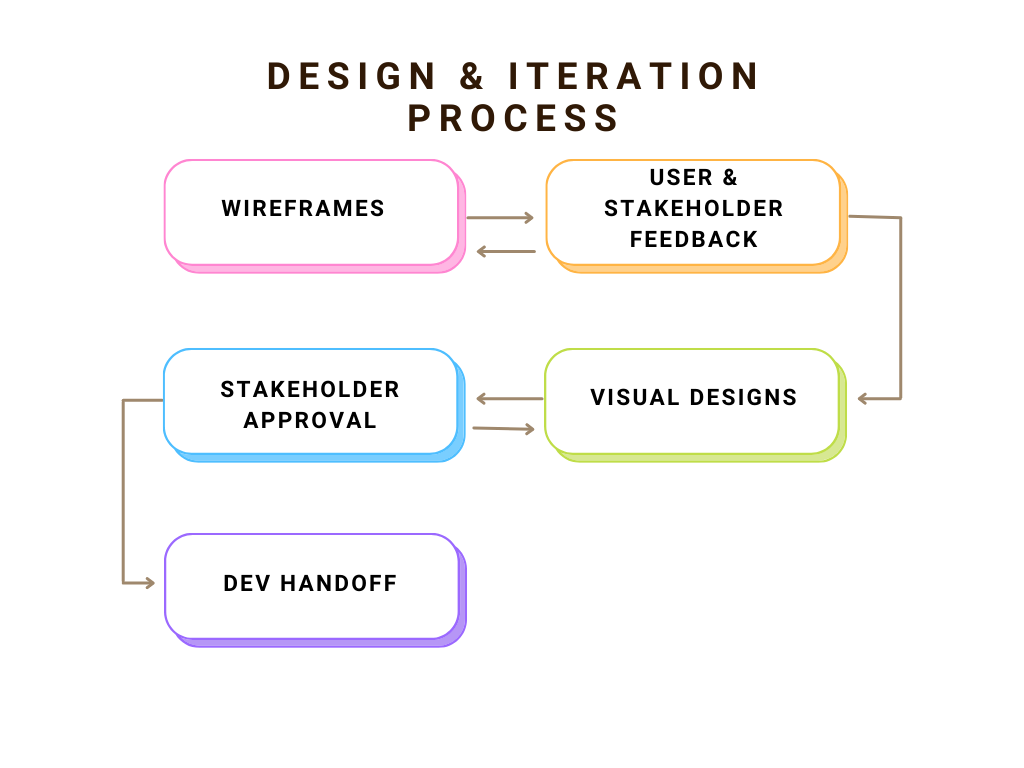
Once prototype testing was complete and we had identified the concepts that performed best against our objectives, we moved into wireframing. Our lead UX designer owned this phase, but I worked closely with them to keep decisions grounded in our user research. I also increased scrum team involvement at this stage to assess feasibility and begin sizing user stories – allowing developers to start planning ahead of hand-off.
As we progressed to visual designs, I presented to business stakeholders, backing our design decisions and managing pushback on out-of-scope requests. Strong stakeholder management at this stage is critical to protecting the scope and quality of the work.
I don't believe in a one-time dev hand-off. By involving the dev team early and throughout the design process, there are no surprises – they understand the user's needs, have helped shape feasibility decisions, and arrive at hand-off with component architecture already planned and high-priority stories estimated.
That's exactly how this project ran. By the time we formally handed off, the scrum team was already self-organising, and my role shifted to clarifying the 'what' and the 'why' as they built.